This Mashhad travel guide starts with the short answer. Most people come to visit the Imam Reza shrine, which is open around the clock and calmest late at night and just after dawn. Spring and autumn are the mildest seasons, and Mashhad is about an hour and a half by air or one night by train from Tehran.
Last checked: October 2026. Flight and train schedules and prices change often; check the live status and price in the site's search before you buy a ticket or book a hotel.
Mashhad is the capital of Razavi Khorasan province, Iran's second-largest city and its busiest pilgrimage destination. The Imam Reza shrine complex is the city's heart, and most hotels, bazaars and busy streets ring it. Pilgrims come from all over Iran, and many foreign visitors are pilgrims from Afghanistan, Iraq and Pakistan, so services in several languages are easy to find around the shrine.
Most visitors stay two to four days: a day or two for the shrine and the bazaar around it, and one day out of town, at Tus and Ferdowsi's tomb or in Torqabeh and Shandiz. Each section below links to a more detailed post.
For weather, spring and autumn are best: the days are mild and walking between courtyards and the bazaar is comfortable. Summer days are hot and winter is cold, but the shrine is busy in every season. The religious calendar matters more than the weather:
- Nowruz (the Persian new year, late March): the busiest time of year; flights, trains and hotels near the shrine fill weeks ahead.
- The last ten days of Safar, especially around 29 Safar, the anniversary of Imam Reza's martyrdom, when many pilgrims arrive on foot or in groups.
- Dahe-ye Karamat, 1–11 Dhu al-Qa'dah, ending on Imam Reza's birthday.
- Summer school holidays, when family trips fill the city.
If you want to be there for one of these, book early; if not, a few weeks away from them means a calmer shrine and lower prices. The month-by-month table is in the best time to visit Mashhad.
Mashhad is about 900 km from Tehran by road, and all four usual ways of getting there run. The choice mostly comes down to time against cost, and how many of you are travelling.
Getting to Mashhad from Tehran (times are approximate)| Mode | Approx. time from Tehran | Best for |
|---|
| Plane | About 1 h 30 min in the air | Short trips and travellers short on time |
|---|
| Regular train (often overnight) | About 10–11 h | Families; you sleep in a compartment and arrive in the morning |
|---|
| Faster train | About 6–8 h | Train fans with less time |
|---|
| Bus | About 12–14 h | Tight budgets |
|---|
| Car | About 900 km; more than 10 h of driving | Groups who also want to explore around Mashhad |
|---|
Shahid Hasheminejad International Airport (MHD) is in the south-east of the city, with flights from most provincial capitals. Iranian flights were suspended in late February 2026 and resumed in phases, and Mashhad airport was cleared for international flights again from late April 2026. Still, check the status in the flights to Mashhad search before you buy.
The overnight train is the classic way to Mashhad: you save a hotel night and step off in the morning close to the shrine. Compartment types and seat tips are in Tehran to Mashhad train, and tickets are on the train tickets page.
From Afghanistan: Kabul flights and the Herat overland route
Pilgrims from Afghanistan usually take a direct Kabul–Mashhad flight (about 1.5–2 hours) or come overland from Herat through the Islam Qala–Dogharoun border. Which airlines fly the route right now changes often; see Kabul to Mashhad flights and Herat to Mashhad overland. First check your visa through official channels and in Iran visa for Afghan citizens.
Both the airport and the railway station are about 8 km from the shrine, so the ride to your hotel is usually short, except at rush hour or on holy days. You have three options:
- Airport taxi or ride-hailing app: the easiest for families and anyone with luggage.
- Metro: Line 1 starts at the airport and crosses the city; from there it is a walk or a short taxi ride to the shrine.
- City bus: the cheapest, but awkward with suitcases.
Which station to use and roughly how long each option takes is in Mashhad airport to the shrine.
Most pilgrims want to walk to the shrine, so the streets around it are full of hotels, apartment hotels and guesthouses. The closer you stay, the easier prayers and night visits are, but in busy seasons prices rise and rooms go first.
- Near the shrine: best for older travellers, families with children and anyone visiting several times a day.
- A little further out, near the metro or a main road: the same access for less; good value on longer stays.
- The outskirts or the Torqabeh–Shandiz road: for visitors who came mainly for leisure and the cooler summer air.
How to choose, and which neighbourhoods to look at, is in hotels near the Imam Reza shrine; compare live room prices in Mashhad hotel booking.
Visiting the Imam Reza shrine: hours, dress code and etiquette
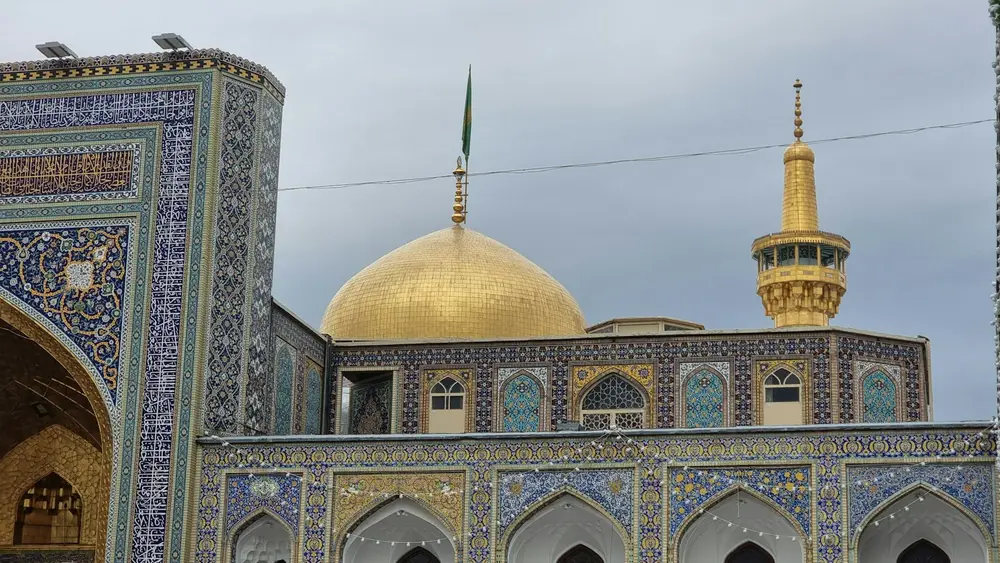
The shrine complex is huge, with many courtyards, among them Enghelab (Atiq), Azadi, Jomhouri Eslami, Qods, Jame' Razavi, Ghadir, Kowsar and Hedayat. The Goharshad Mosque, a Timurid monument with a turquoise dome, stands on the complex's south side. There are many gates, so agree on a meeting point with your group.
Yes, the shrine is open 24 hours a day. The calmest times are from midnight to before dawn and just after the dawn prayer. Around congregational prayers, on Thursday nights and on holy days the courtyards get very crowded; if you are with older relatives or children, go at quiet hours.
Dress code and entry
- Women wear a chador to enter the shrine; if you don't have one, you can borrow one at most entrances.
- Men should wear modest, tidy clothes; shorts are not appropriate.
- Men and women use separate entrances, with a body search at the gate.
- Leave large bags and cameras at the deposit desks by the entrances; phones are usually allowed.
- Keep your voice down in the halls and don't block the walkways in a crowd.
The shrine's guesthouse serves a blessed meal (ghaza-ye hazrati) to a number of pilgrims every day. Places are given by lottery, with registration through the official channels of Astan Quds Razavi, such as the Rezvan app. The rules change from year to year and nothing is guaranteed, so check the official announcements before you travel.
The shrine has an office for foreign pilgrims that hands out brochures and offers free guides in several languages. Non-Muslim visitors may see the courtyards, but some central areas may be closed to them; follow the guide's lead. The Astan Quds Razavi museums, including the central museum on the west side of the Kowsar courtyard, are inside the complex and worth an hour or two.
Things to do in Mashhad, from the shrine to Tus and Shandiz
With a spare day, the sights split into two groups: those within a walk or a short taxi ride of the shrine, and those that need half a day. Distances are approximate and measured from the city centre.
Things to do in and around Mashhad| Sight | Location and approx. distance | Why go |
|---|
| Goharshad Mosque | Inside the shrine complex, south side | Timurid mosaic tilework and a turquoise dome |
|---|
| Astan Quds museums | Inside the shrine, west side of the Kowsar courtyard | Rare Qurans, carpets, coins and the shrine's history |
|---|
| Reza Bazaar | About 1 km from the shrine | Covered bazaar for saffron, rock candy, turquoise and perfume |
|---|
| Nader Shah's tomb | City centre, a short distance from the shrine | Tomb of the founder of the Afsharid dynasty, with a weapons museum |
|---|
| Kooh Sangi Park | South-west of the city | Evening walks and children's rides |
|---|
After the shrine, start with the Reza Bazaar; its shrine-side entrance is the busier one. If you like history, Nader Shah's tomb and its garden are in the city centre, and several Qajar-era houses nearby are open to visitors. Museums and historic houses keep limited hours, so go in the morning.
Around Mashhad: Tus, Torqabeh and Shandiz
Tus is Ferdowsi's hometown, and his tomb is about 25 km from Mashhad; a morning is enough. Torqabeh and Shandiz sit in the hills west of the city, with cooler air and garden restaurants, and most visitors go in the late afternoon and stay for dinner. The road is busy at weekends and in summer, so leave early.
With children, visit the shrine at quiet hours and fix a meeting point; the courtyards are vast and it is easy to get separated in a crowd. Kooh Sangi and Mellat parks are good for evening play, and an afternoon in Torqabeh beats the bazaar for most kids. A hotel near the shrine lets them rest between outings.
1. günDay 1: the shrine and the bazaar
- 05:00
Shrine visit after the dawn prayer
The quietest hour in the courtyards
- 10:00
Astan Quds museums and the Goharshad Mosque
- 17:00
Reza Bazaar
Saffron and rock candy
2. günDay 2: out of town
- 09:00
- 13:00
Food and souvenirs in Mashhad
Mashhad's best-known food experience is shishlik and lamb kebab at the restaurants of Shandiz and Torqabeh. In town, try sholeh mashhadi, a thick stew of meat and pulses, and the restaurants around the shrine serve chelow kebab and simple Iranian dishes. On busy days they queue, so eat lunch a little early.
- Saffron: Mashhad's best-known souvenir; buy sealed, labelled packs from reputable shops.
- Barberries: a Khorasan product sold all over the city's bazaars.
- Saffron rock candy (nabat): one of the most popular pilgrim gifts.
- Turquoise: Nishapur turquoise is everywhere in the Reza Bazaar; ask for a certificate for an expensive stone.
- Perfume, prayer mats and prayer beads: pilgrimage souvenirs from the streets around the shrine.
There is no single figure for a trip to Mashhad; it depends on the season, the size of your group and where you stay. Instead of guessing, add up these parts:
- Getting there and back: flying is usually faster and dearer, the train saves a hotel night and the bus is cheapest. Prices rise around Nowruz and holy days.
- Accommodation: the biggest share; distance to the shrine, season and hotel class set the price.
- Food: restaurants around the shrine are usually cheaper than the garden restaurants of Shandiz.
- Getting around: metro and buses are cheap; ride-hailing is good value for families.
- Day trips and souvenirs: budget separately for Tus, Torqabeh, Shandiz and saffron.
Check live ticket and hotel prices on the site; the earlier you book, especially for busy periods, the more choice you have.
Spring and autumn for the weather. For a calmer shrine and lower prices, avoid Nowruz, the last ten days of Safar and Dahe-ye Karamat.
Yes. It is open around the clock, and late at night and just after the dawn prayer are among its quietest hours.
The flight takes about an hour and a half and suits short trips. The overnight train saves a hotel night and is comfortable for families.
A direct Kabul–Mashhad flight takes about 1.5–2 hours. The airlines on the route change, so check your visa and the flight status before you travel.
How far are Torqabeh and Shandiz from Mashhad?
Torqabeh is about 18 km and Shandiz about 30–40 km from Mashhad; evening traffic adds to the journey.
Bu seyahati planlayın
MHDMeşhedİran
About an hour and a half by air from Tehran; Kabul has had direct flights too.